
What the garden knows about waiting.
By Reverend Harvey Gibbons · with notes from a reading aloud. Time to read: about eight minutes.
· Smale's Cottages, Oswestry
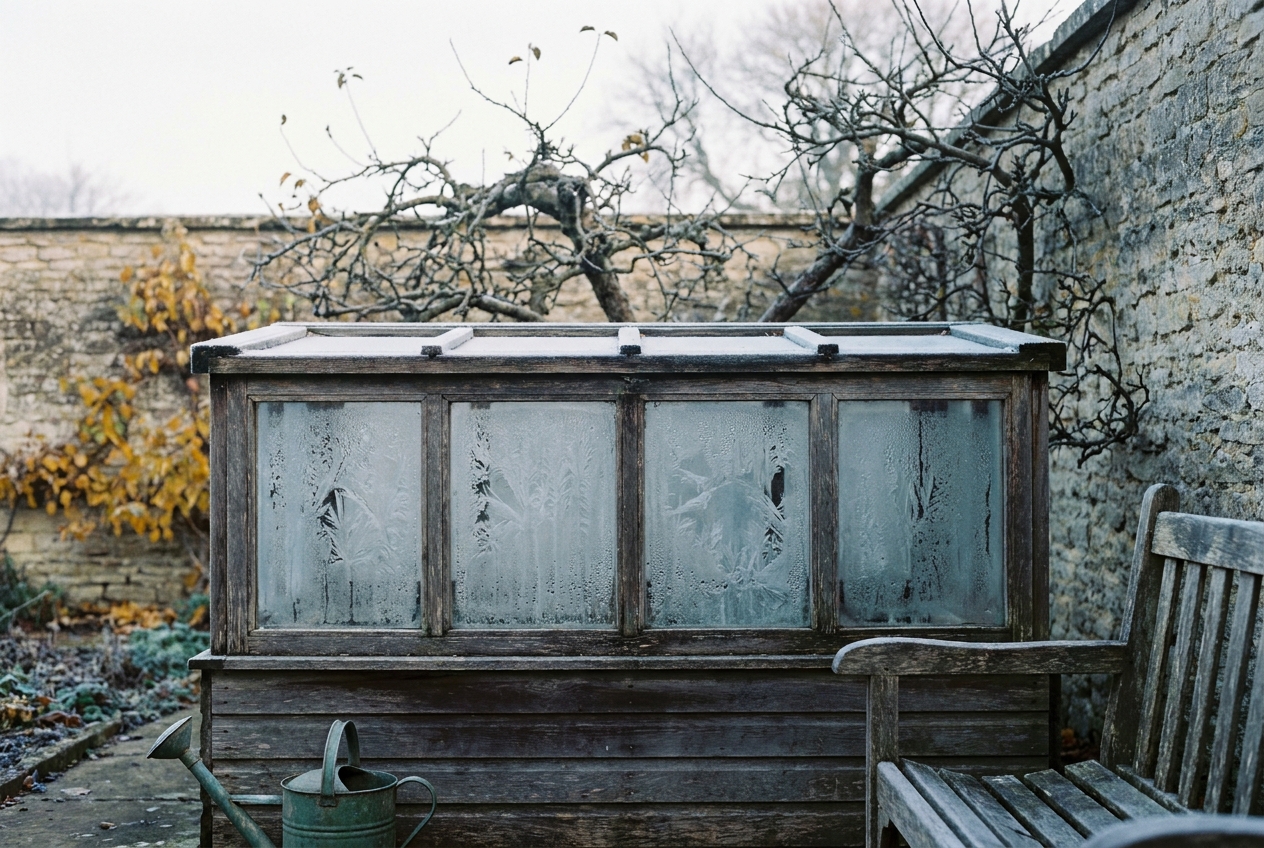
Elspeth Hampton came to Smale's Cottages in the autumn of 2021. She was eighty-six. Her husband Edward had died in the spring; she had spent the summer in the Brecons, with her sister, and had come home to a Whittington bungalow that, she said, “smelt of nobody”. The bungalow had three bedrooms and a long lawn she could no longer mow. The trustees met her at the kitchen table in October. By the first week of November her boxes were unpacked at No. 9, and she had begun what she calls, with an old teacher's precision, “my long waiting”.
Elspeth is now eighty-eight. She reads, she says, more than she has read in decades; the library walker visits her last on a Tuesday, and stays the longest. She has, in her four years with us, finished one hundred and seventy-four books, has put down only six, and has — to my private astonishment — taught herself, in her cold front room, to read aloud in Welsh.
An apple tree at the back of the garden
The walled garden behind Eure's Row has a single old apple tree against the south wall. It is, by the trust's records, at least eighty years old; it may be older. It is a Bramley's seedling, grafted onto an unknown rootstock, and it carries, in a good year, perhaps four hundred pounds of fruit. It is, by every horticultural measure, near the end of its working life.
Elspeth has decided to outlast it.
She made this decision in the November of her first year. She walked through the walled garden on her second day in the cottage; Thomas, our senior gardener, was pruning the apple step. He gestured to the old tree at the back and said, “She'll not see another decade, mind.” Elspeth looked at the tree for a long time. Then she looked at Thomas. Then she said, “Well. We'll see.”
Reading at the cold frame
In the winter, when the front room is too cold to sit in for long, Elspeth wraps up and walks the few steps from her back door to the cold frame. She sits on the bench beside it — Thomas made the bench from old roof timbers in 2019 — and she reads, out loud, to the cold frame and the apple tree.
I did not know she did this for the first two years. I learned about it because Thomas told me, in the lean-to in the spring of 2024. “She reads aloud,” he said. “In Welsh. I don't know what she's reading, but it sounds beautiful. The robin sits on the apple step and listens.” I asked her about it that summer, in the gentlest way I could. She did not seem embarrassed. “I read,” she said, “because the silence is enormous. And the apple tree, you know, has very good manners.”
It turns out she has been reading her way slowly through R.S. Thomas. She had not, before she came to us, read very much Welsh; she has, in the past three winters, taught herself to read aloud in Welsh with an old Geiriadur her grandfather left her. The library walker has now ordered her a parallel-text edition of Selected Poems; it sits on the bench in the cold frame on Tuesdays.
“I read because the silence is enormous. And the apple tree, you know, has very good manners.” — Elspeth Hampton
What waiting is for
I think a great deal, in my work as a parish priest, about what waiting is for. The Christian year is, in large part, a year of waiting — Advent, Lent, the long slow time between Trinity and Christ the King — and so is, in its own way, the year of an almshouse. We wait for the slates to be quoted; we wait for the residents to arrive; we wait, eventually and quietly, to say goodbye. We wait for the apple tree to die, and Elspeth waits to outlast it.
It is, on the face of it, a strange small ambition. But it has, in the four years I have known her, given her a shape to the year. She watches for the first blossom in May; she watches for the first windfall in July; she watches for the colour to leave the leaves in October. She has not, in all that time, asked the trust for very much. She has not asked us to fix anything, or to install anything. She has asked, once, for the bench to be moved six inches to the left, so that the south light fell on the page of her book in the afternoon.
A note for our donors
I write this in late January, in the side room at St Oswald's, with the rain on the window. We have a few new donors to the Eure's Row roof appeal this month, and several of them have written to ask what their money does. The honest answer is what you have just read: it pays for a roof to be repaired, so that a woman of eighty-eight can sit at a cold frame and read R.S. Thomas to an apple tree.
If this seems a small thing to ask donors to support, I would gently ask you to read the paragraphs above again. The smallness is precisely the point.
— HG · St Oswald's Side Room · 21 January 2026