
The quiet work of Monday mornings.
By Brighid Carey, trustee · with notes from the gardener's table. Time to read: about nine minutes.
· The walled garden, Eure's Row
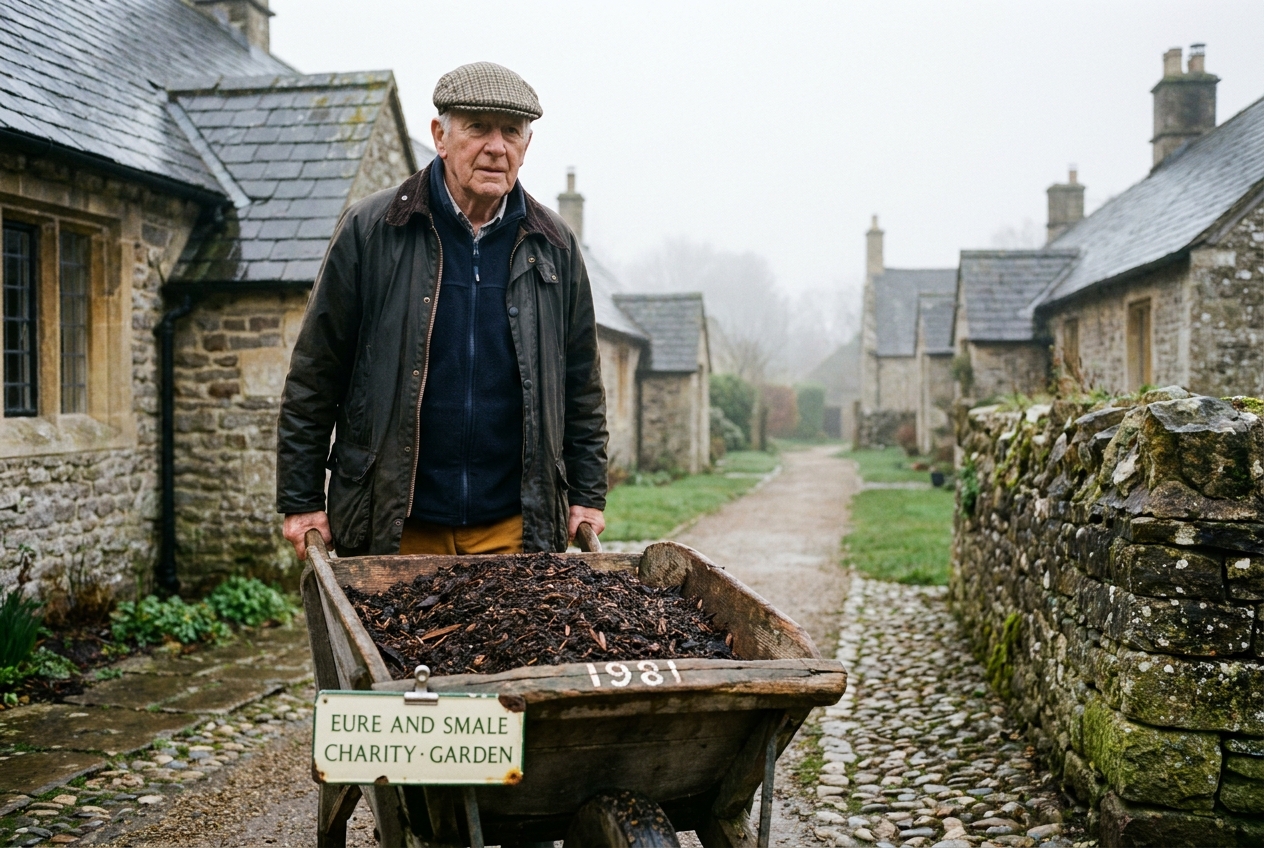
There is a wheelbarrow in the walled garden behind Eure's Row that has been in continuous use since 1981. We know the year because it is painted on the inside lip in white emulsion, by the previous gardener, who liked to keep records and disliked filling them in twice. The barrow is wooden, with a pneumatic tyre that has been replaced four times. It has carried, by my estimation, in the order of two thousand loads of compost. It has its own corner in the lean-to. It has, since 2019, been pushed almost exclusively by a retired long-haul driver called Bert.
Bert is seventy-nine. He drove articulated lorries for forty-one years, mostly the Hull-to-Liverpool route via the A55, and retired in 2015 with a bad shoulder and a sense, he told me, of having “run out of road”. He came to the trust by way of his GP, who lives on Cross Street and serves on the practice manager's committee with one of our trustees. Bert arrived at the back gate of the garden on a Tuesday morning in October 2018, in a wax jacket and a Liverpool FC bobble hat, looking, I am told, as though he had not been outside without a steering wheel in his hand since 1974.
What Mondays are for
Most of the garden volunteers come on a Tuesday. Bert prefers Mondays. The reason, he says, is that Mondays do not feel like “proper days yet”. Tuesday is the day the residents put the bins out; Wednesday is befrienders; Thursday is the parish post; Friday is the run-up to Saturday. Monday is the morning before any of that — “a day that hasn't yet been told what it's for”. He likes that about it. He likes a slow start, with the frost still in the cold frame and the robin sitting on the apple step waiting for him to turn the compost over.
The Monday work is not glamorous. He weeds the long border, top to tail. He turns the compost, which lives in three slatted bins along the north wall. He empties the pots that have died in the lean-to. In February he prunes the apple step, with a small folding saw he keeps in his jacket pocket and a tin of wound paint he keeps in the lean-to. By half past eleven the kettle is on. By twelve he is gone, with the wheelbarrow tucked back into its corner, the gate locked, and a faint smell of compost still on his hands.
The compost heap as a philosophy
Bert thinks about the compost heap a great deal. He has, he says, learned more from it in seven years than he learned from forty years on the road. The compost teaches him three things: that you cannot rush it; that the more you turn it, the better it becomes; and that the end of one thing is the beginning of another. He has tried to apply this to his own life, with — he says — “middling success”.
He has not tried to apply it to the lives of the residents, which I think is important. One of the things we have asked the garden volunteers to keep faith with — and it is, I think, the hardest thing we have asked of them — is to garden in the presence of the residents without becoming part of their care. Bert is not a befriender. He does not visit at kitchen tables. He waves at Mavis at her bay window and at Elspeth at her back door, but he does not sit down. He is here for the garden, on a Monday, and the residents have made their own peace with the garden in their own way.
“The compost teaches you that you can't rush a thing. I should have learned that on the road; I learned it from a heap of vegetable scraps at the age of seventy-three.” — Bert
The barrow as an inheritance
The barrow's age — forty-five years and counting — is, in its way, a portrait of the trust. We do not replace things easily. We replace the tyre when it fails. We replace the handles when they split. The frame is original, and the painted lip still reads 1981 in slow, careful white emulsion, in the hand of a gardener who died in 1996. Bert knows this. He keeps the barrow oiled. He has, twice now, made a small wooden patch for a crack in the body — the second one is dated, lightly, in pencil, on its underside: B.A. 09/22.
I asked him, once, what would happen to the barrow if it became unusable. He looked at me as though I had asked what would happen to the church if it caught fire. “We'd patch it again,” he said. “Or I would, anyway. While I'm here.”
What it gives back
This is the part I have not known how to write. The garden gives Bert something, though Bert is not a man who is good at saying what. After a morning's work, he sits at the table in the lean-to and writes, in a small notebook, two short sentences: what he did, and what he noticed. The notebook now runs to seven volumes. They are not for us; they are not for the records. They are for him.
I have read one of them, with permission. The entry for 12 February 2024 reads, in full: “Pruned apple step. Robin back. Felt better than I have in a year.” I have not been able to think of an annual report sentence I would rather have written.
A small note in closing
If you have read this far, and are minded to volunteer with us — perhaps in the garden, perhaps elsewhere — please do write. We have, at present, two open Monday slots and a quiet Tuesday in May. We are also, as Bert is fond of reminding us, always in need of a person willing to sit at the table in the lean-to and drink the second pot of tea.
— BC · The lean-to · 04 March 2026