
A doorway still open: Mavis at No. 3.
By Reverend Paul Trevor Darlington · with photographs by Brighid Carey. Time to read: about eleven minutes.
· Eure's Row, Beatrice Street, Oswestry
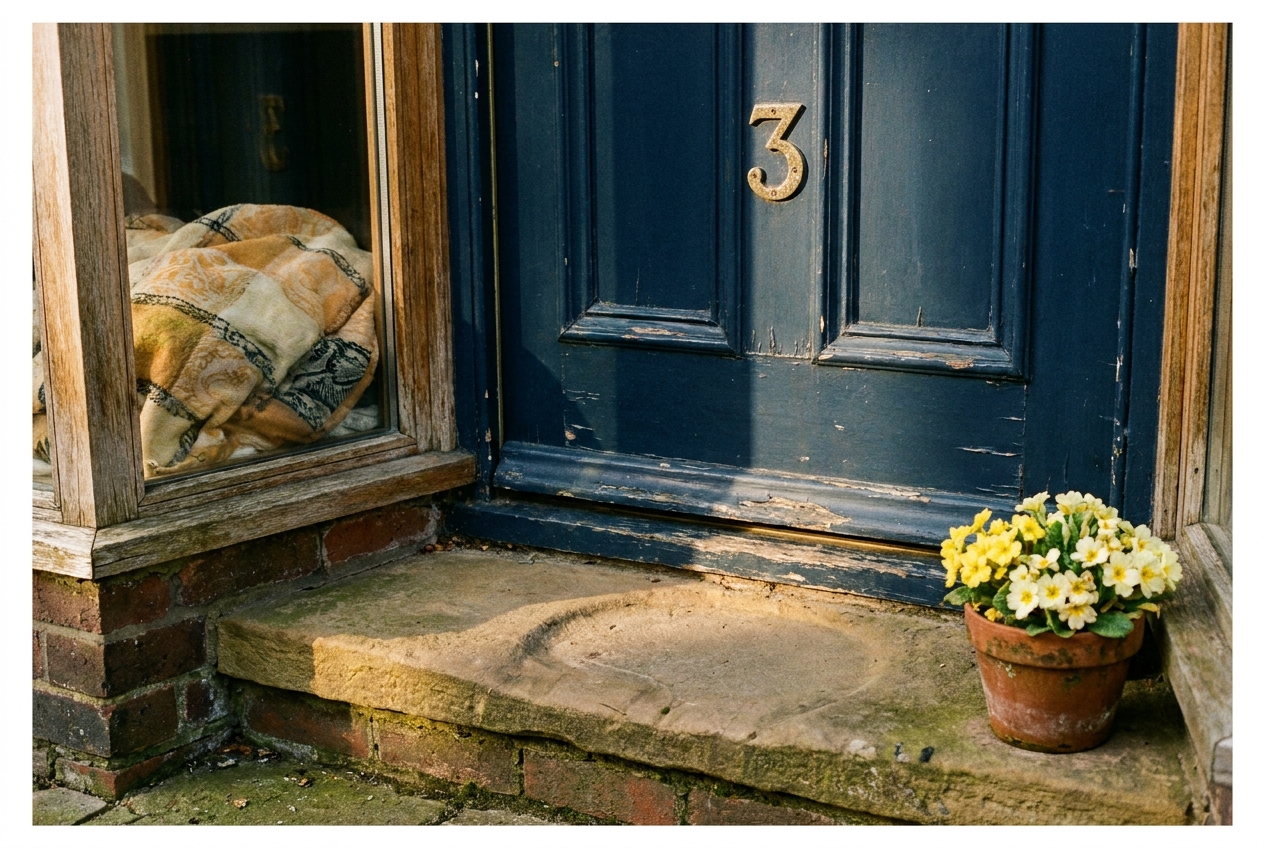
Mavis Allbright is eighty-four. She has lived at No. 3 Eure's Row since the spring of 2019. Before that she had, in her own words, “lived in the same street for sixty-two years” — a terrace down by the canal, three roads from where she sits now, in a sunny bay window with a small mug of tea and a lap-blanket she has been knitting since Stir-up Sunday. She came to us in the week after her late husband Frank's seventy-ninth birthday, which would have been his last. She had thought a small house would feel like a smaller life. It has not. It feels, she says, “like a great kindness from someone who died three centuries before I was born.”
I have known Mavis for almost twenty years, since I first walked into St Oswald's in 2005. In all that time she has been a person you notice for her quietness in church and her wit in the side hall, which are not the usual combination. The day she moved to Eure's Row, she stood at the threshold with her cardboard box of kitchen things, looked at the doorstep, and said, “Well, vicar, I never thought I'd live in a place with a step that's been worn by other women's feet.” It is, I think, the kindest thing she has ever said to me.
The street she came from
Mavis grew up on Coney Green, two streets from where Beatrice Street meets the road out to Whittington. Her mother was a seamstress; her father drove a coal lorry, in the days before the trade was respectable and after, in the days when it was. Mavis left school at fourteen, worked as a counter clerk at the Co-op on Cross Street, then for thirty-six years on the till at the Oswestry Bookshop. She married Frank in the summer of 1962, in the church I now serve. The reception was in the very side room where I take the trustees' minutes.
She and Frank lived on the same street for sixty-two years. They had two children, both of whom moved away — one to Liverpool, one to Carmarthen — and a great many friends, almost all of whom also stayed. The trouble, Mavis says, is that the friends began to die. “First Joyce, then Walter, then little May, then Frank.” After Frank's heart attack in the September of 2018, Mavis stayed in the terrace alone for the winter. By March it had become, she said, “a house I'd been left to caretake by a stranger.”
The trustees met her at her kitchen table on a Wednesday morning. We did not ask whether she could afford the cottage; we asked, in turn, what she read, what she liked to cook, and whether she liked a cold room or a warm one. She liked them warm. We had her on the list of recommended residents by the close of business.
The doorway
The front door of No. 3 is, like all the doors on Eure's Row, painted in the “Eure blue” specified in our 1859 trustees' minute. It is closer to a navy than a French blue — the recipe came, originally, from a colourman in Shrewsbury, and we have it remixed each decade by a paint firm in Welshpool who keep our note on file. The brass numerals are original to 1748, screwed into the oak above the lintel. The step is sandstone, quarried at Grinshill, and it has been worn into a shallow scoop in the middle by, as Mavis correctly observed, several other women's feet.
I have come to think of that doorstep as the moral centre of our work. It marks the boundary between the public street and a private home; the line at which a trustee waits to be invited in. We knock; we wait. We do not, in any circumstance, use a key to enter a resident's home unless we have explicit permission and a clearly stated reason — the bathroom tap leaking, a chimney sweep arriving — and we leave again as quickly as we have come.
“I never thought I'd live in a place with a step that's been worn by other women's feet. It does feel like that, you know. Like a queue of patient women, waiting to lend me a chair.” — Mavis Allbright
What seven years inside has done
Mavis is now in her seventh year at No. 3. She has, in that time, watched four new residents arrive across the courtyard, attended six trustees' meetings (the open quarter-hour), and learned the names of every befriender in the Hearth & Hand programme. She has knitted, by my count, eleven lap-blankets — one for each new resident, one for her great-niece, and one for the trustees' chair, which I still keep across the back of my office chair.
She reads more than she did. The library walker — first Pat, then John, now Brighid — has, between them, brought her three hundred and twelve books since she moved in. She keeps a list of the ones she has finished in the back of her diary, in a column headed “read all of”. The column is up to two hundred and ninety-one. She has, she says, “put down” twenty-one books in the past seven years. She thinks this is a low number.
She has also taken on, quietly, what I have come to think of as the senior-resident's role. She is the first person a new arrival meets across the courtyard. She is the one who explains where the bins go, which key opens the back gate to the walled garden, and how to ask the coal merchant to leave the sacks on the right of the back door rather than the left (it is closer to the kitchen). None of this is in any document of ours. It is, simply, what a long-resident neighbour does.
What it has cost us
I have been asked, on more than one occasion, why the trust does not house more people. It is a fair question, and I would like to answer it carefully. The Eure and Smale Charity could, in theory, sell the Smale's Cottages site, buy a small block of new-build flats on the edge of Oswestry, and house perhaps eighteen people for the price of housing twelve. We do not plan to do this.
The reason is in the worn step of No. 3. It is in the brass numerals from 1748, the slates from Penrhyn, the Eure blue from Welshpool, the apple step in the walled garden, the bench by the back door of No. 4. We have inherited a place — a particular, named, located, three-century-old place — and we have inherited it for the people who live in it. To trade it for a new-build off the bypass would be to discharge the duty of housing without discharging the duty of place. They are not the same.
What lies ahead for Mavis
Mavis is eighty-four. She is in good health for her age, but she has had a small fall this winter and is now, since February, using a stick when she walks across the courtyard. We have, at her request, installed a second handrail beside the front step and replaced the kitchen-tap washers — the leaking had been driving her, she said, “up the wall, which is itself bad for someone of my hip.”
She intends to stay at No. 3 “for as long as the trustees will have me, and a year or two longer if they will let me”. We will have her, of course, for as long as she wishes to stay. The trustees do not move residents on; the only departures, from any of our cottages, are by choice or by the natural course of a long life.
I asked her, before I left, what she would tell a new resident about the place. She thought about it for a long time. “Don't try to know everyone all at once,” she said, eventually. “The whole point of it is that we get to know each other slowly. There is no hurry. There never was.”
— PTD · St Oswald's Side Room · 14 April 2026